
How Does an Automatic Parking Barrier System Work?
Release time:
2026-11-03
An automatic parking barrier system controls vehicle entry and exit by combining a physical boom gate with access authorisation, vehicle detection and a control unit. In Singapore, this setup is commonly relevant to condominium car parks, commercial buildings, office developments, industrial premises and public parking facilities. Depending on the site, the authorisation method may use an RFID card or tag, automatic number plate recognition (ANPR/LPR), a ticketing or payment system, or another approved access-control platform.
1. What Are the Main Components of an Automatic Parking Barrier System?
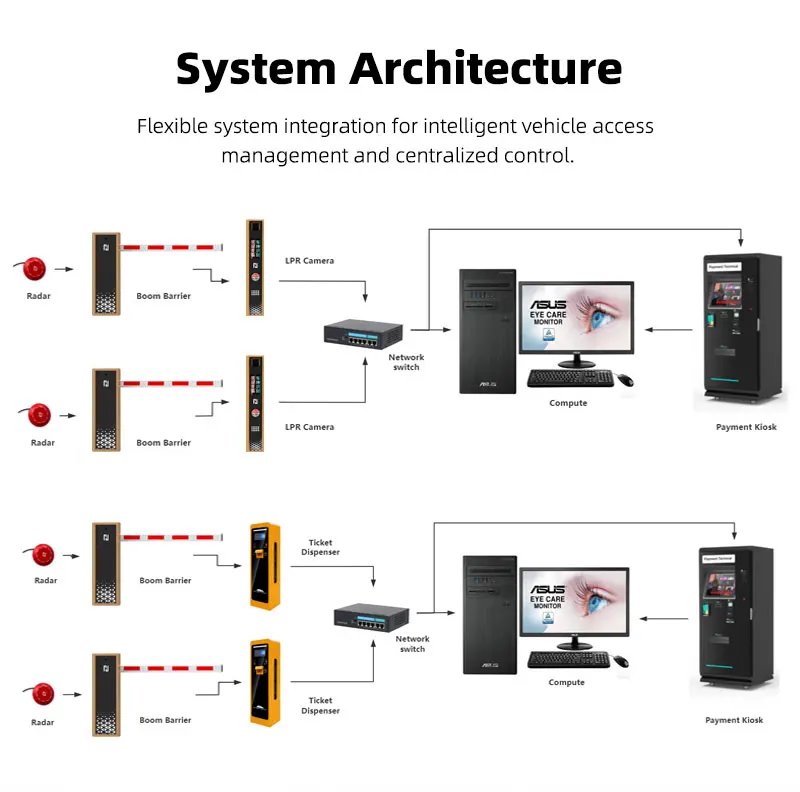
A typical installation contains several coordinated components. The exact configuration depends on traffic volume, lane layout, security policy and the parking management platform already in use.
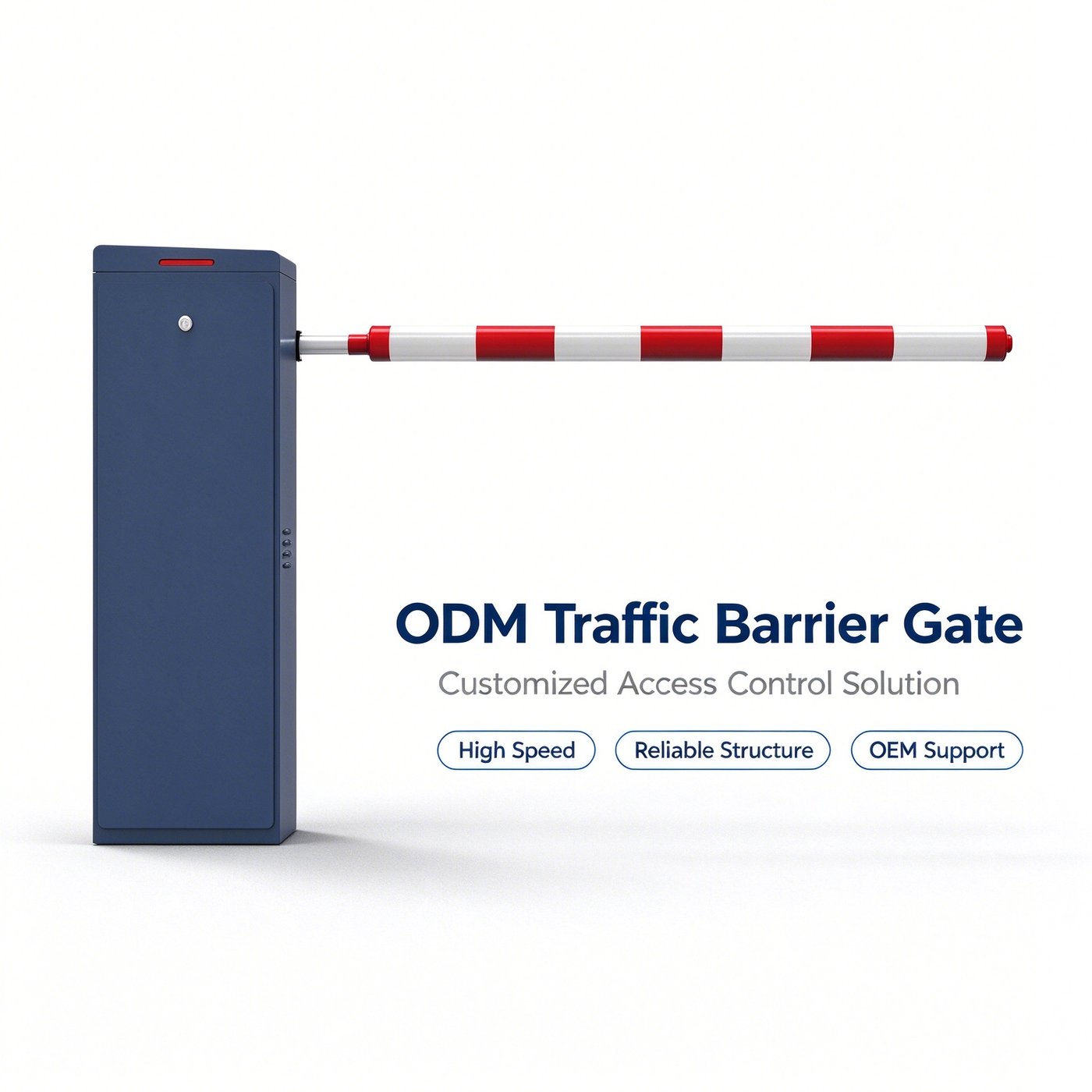
- Boom barrier gate: The motorised unit raises and lowers the barrier arm to control the lane.
- Controller and control board: Receives access and sensor signals, then coordinates the opening and closing sequence.
- Access reader or recognition device: May be an RFID reader, LPR/ANPR camera, ticket reader, keypad or another authorised credential device.
- Vehicle detector: A ground loop, radar sensor or other compatible detector can indicate vehicle presence and help manage the barrier cycle.
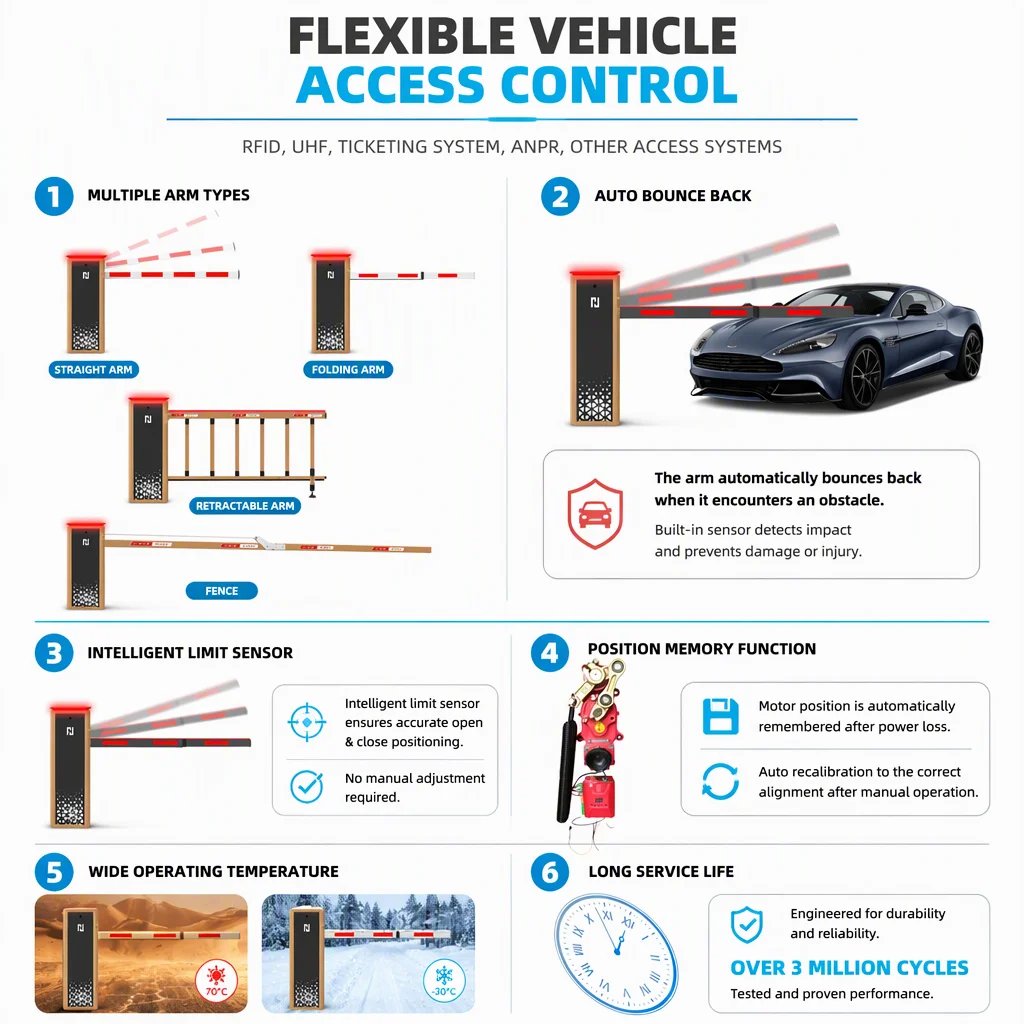
- Safety devices: Depending on the design, these may include anti-crash detection, loop detectors, photocells or automatic-reverse logic.
- Parking management software: When integrated, it can manage permissions, records, payment events and entry/exit data.
- Power and communications: Power supply and interfaces connect the gate with the readers, sensors and management platform.
2. How Does the System Work Step by Step?
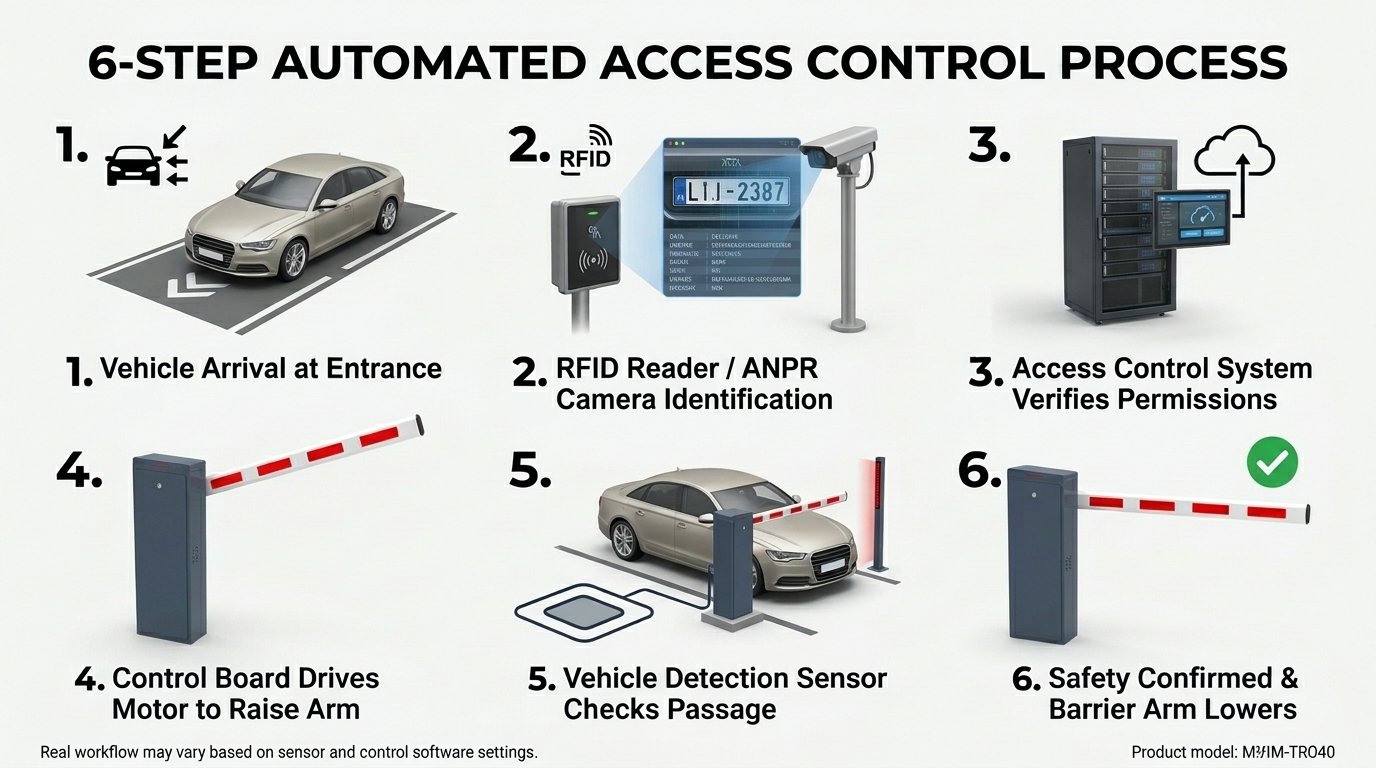
Step 1: A vehicle approaches the entry lane
A vehicle approaches the car park entrance and stops at the designated detection or reading point. A loop detector, radar sensor or other configured device may detect the vehicle and notify the controller that a vehicle is waiting. Correct positioning and lane design help prevent the detection area from overlapping with nearby traffic.
Step 2: The driver or vehicle is identified
The system checks whether the vehicle has permission to enter. With RFID access, a registered card, tag or transponder is read by the compatible reader. With LPR/ANPR, a camera captures the number plate and recognition software compares the result with the authorised vehicle list or the rules configured in the parking platform. Other sites may use tickets, QR codes, PINs or an attendant-operated approval process.
Step 3: The controller verifies the access result
The access-control device or parking software sends an authorisation result to the barrier controller through the configured interface. BAROXON's product information describes integration options such as TCP/IP, Wiegand and RS485 for compatible systems. The actual interface and communication protocol must be confirmed for the selected devices; not every combination supports every function without configuration or an interface module.
Step 4: The boom arm opens
When the controller receives a valid opening command and the safety conditions are satisfied, the motor drives the boom arm upwards. Opening speed varies by model, arm length, motor, settings and site conditions. BAROXON lists high-speed models and adjustable operating speeds; the specification for the selected model should be used rather than assuming one speed applies to every installation.
Step 5: The vehicle passes through the lane
The driver proceeds only when the boom is fully raised and the lane is clear. Vehicle detectors and safety devices help the controller determine whether a vehicle is still within the operating area. The precise detection arrangement is important: a poorly positioned sensor or incorrectly configured controller can increase the risk of the arm lowering at the wrong time.
Step 6: The system confirms the lane is clear and closes the barrier
After the vehicle has passed and the configured detection logic confirms the lane is clear, the controller initiates the closing sequence. Depending on the installation, this may rely on a loop detector, radar, photocell or a combination of devices. Safety logic should be designed and tested so the barrier does not close onto a vehicle or obstruct a person.
Step 7: The access event is recorded
If the barrier is connected to a parking management platform, the system may record the recognised plate or credential, entry time, access decision and other configured event data. With the appropriate integration, the same platform may also coordinate payment, ticketing, occupancy information or reporting. The available records depend on the software and integration scope, not the barrier gate alone.
3. Automatic Parking Barrier System: A Simple Process Flow
Vehicle detected → Credential or number plate checked → Access decision sent to controller → Boom arm opens → Vehicle passes → Lane-clear signal confirmed → Boom arm closes → Event logged (if integrated).
4. RFID vs LPR/ANPR: Which Access Method Is Used?
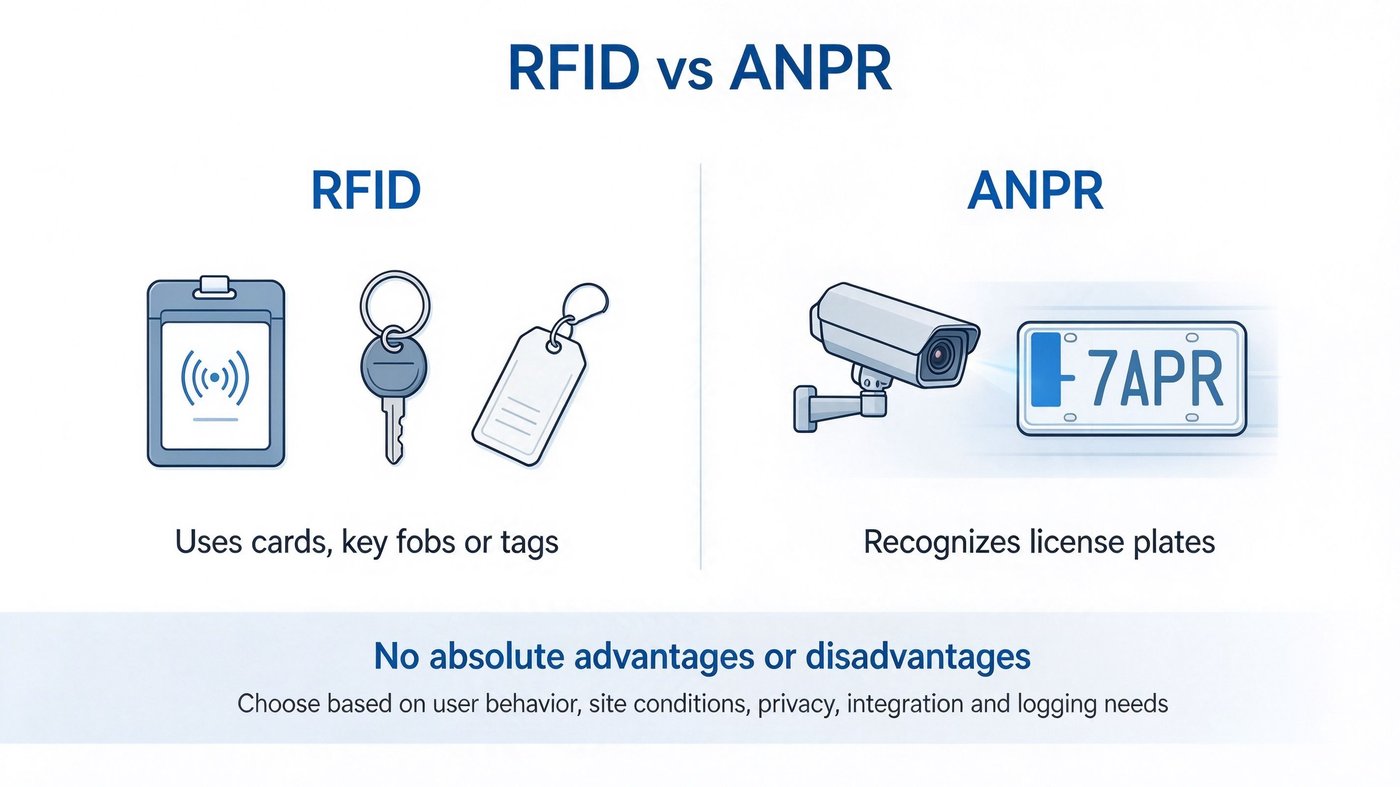
RFID boom barrier
RFID access is suitable for sites where registered users carry a compatible card, tag or vehicle transponder. It can support controlled access for residents, staff, fleet vehicles or other authorised users. The reading range and performance depend on the reader, credential type, installation position and local operating conditions. An automatic RFID boom barrier is a common choice for condominiums and season-parking schemes.
LPR/ANPR parking barrier
LPR/ANPR uses a camera and recognition software to read vehicle number plates. When connected to a parking management system, it can support ticket-free entry and exit, authorised vehicle lists and other configured workflows. Image quality, lighting, camera angle, plate condition, network reliability and the software rules all affect recognition performance. Review an automatic LPR parking barrier system against the site's access rules.
Hybrid access
Some sites use more than one method, such as LPR for regular vehicles and RFID or manual approval for exceptions. The design should define what happens when a plate cannot be read, a credential is rejected, the network is unavailable or a visitor requires assistance.
5. Why Vehicle Detection and Safety Devices Matter
Access authorisation answers the question "may this vehicle enter?" Vehicle detection and safety devices help answer "is it safe to move the boom now?" These are different functions and should be planned separately. A valid access signal alone should not be treated as proof that the boom's movement area is clear.
For a Singapore installation, review the approach gradient, lane width, turning space, pedestrian movement, rain exposure, lighting, peak-hour queues and access for maintenance. Select compatible detectors and have the safety sequence tested during commissioning. Confirm project-specific requirements with the installer, building management and relevant authorities where applicable.
6. How Fast Does an Automatic Parking Barrier Open?
There is no single opening time for all automatic parking barrier systems. Speed depends on the motor and controller, boom length and weight, operating mode, safety settings and actual site conditions. BAROXON's product pages describe high-speed models and model-specific figures, including a stated 1.1–1.5 second 90-degree lift for a particular configuration tested with a 3 m aluminium boom at 25°C. This is a model-specific test result, not a universal guarantee for every barrier.
When comparing options, assess the complete lane cycle rather than the lift time alone. Recognition speed, driver response, vehicle spacing, payment processing and closing logic also affect throughput and queue length. A faster motor does not automatically eliminate congestion if the lane layout or access workflow is the bottleneck.
7. Can an Automatic Parking Barrier Integrate with Existing Systems?
BAROXON describes compatible integration options for LPR/ANPR, RFID, radar vehicle detection and third-party parking, payment or access-control platforms. Published interface options include TCP/IP, Wiegand and RS485 on compatible configurations. Before ordering, document the existing software, reader types, network arrangement, input/output signals, payment workflow and the responsibilities of each supplier. Confirm interoperability and required interface modules in writing. For camera-based installations, review a vehicle access control barrier gate with LPR camera against the existing platform.
For sites with an existing car park management system, integration testing should cover normal entry and exit, rejected access, duplicate reads, network interruption, power recovery and manual override. This helps ensure that the barrier, reader, sensors and software work as one coordinated system rather than as separate devices.
8. Where Are Automatic Parking Barrier Systems Used in Singapore?
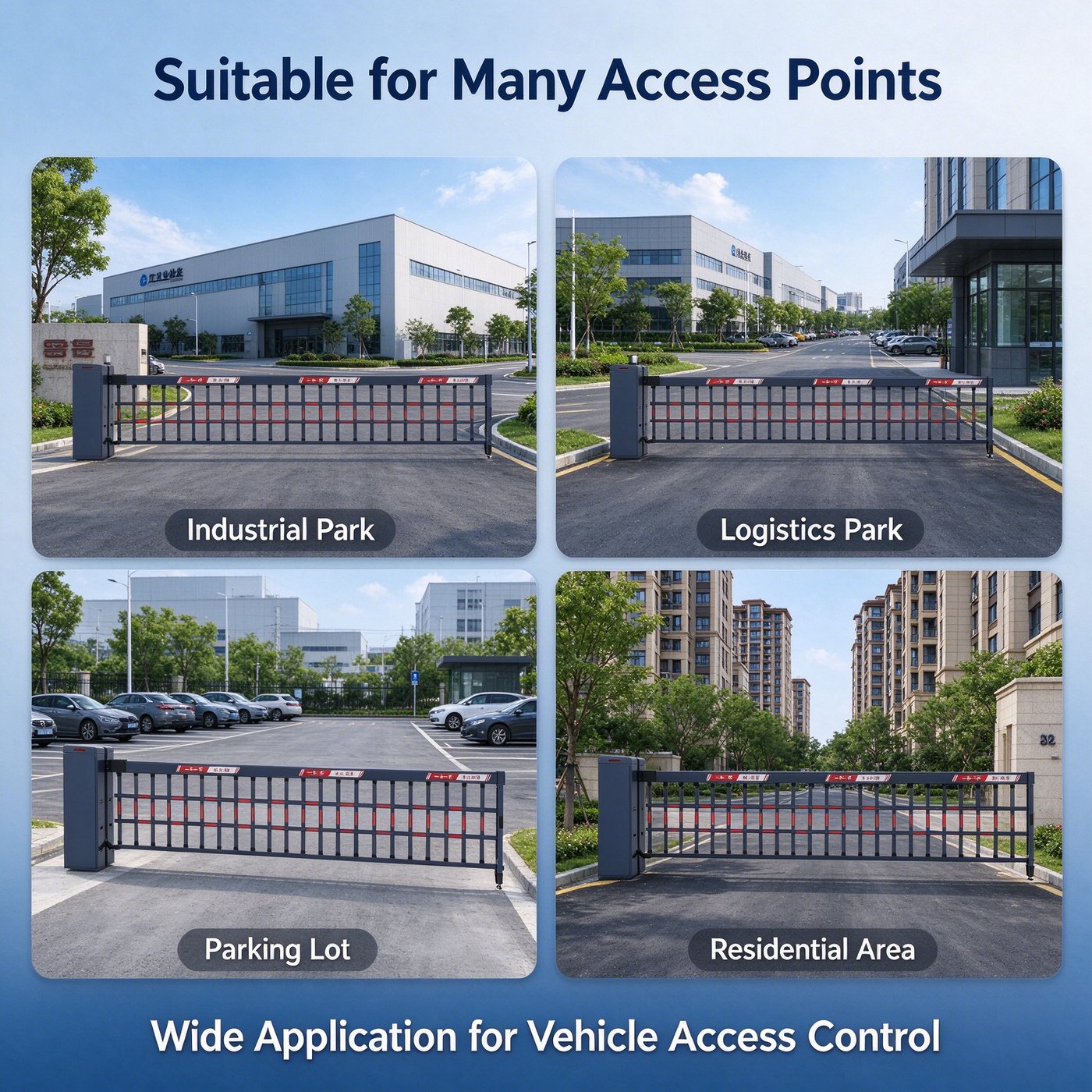
- Condominiums and residential developments: Manage resident and visitor vehicle access, with a defined process for guests and delivery vehicles.
- Commercial buildings and office car parks: Support staff, tenant and visitor access rules, and integrate with parking operations where required.
- Retail and public car parks: Coordinate entry/exit, ticketing or ticket-free access and payment workflows.
- Industrial sites and logistics facilities: Manage frequent vehicle movements, including authorised staff and delivery vehicles.
- Transport or high-throughput facilities: Consider high-speed barriers and a carefully engineered lane system where traffic demand justifies them.
9. How to Choose the Right System for Your Site
Start with the operating requirements, not just the barrier price. Record the lane width, boom length, expected vehicle count during peak periods, vehicle types, access methods, outdoor exposure, available power, network connectivity and maintenance access. Then confirm the opening speed and duty-cycle requirements with the manufacturer based on the actual arm configuration and expected usage. The full BAROXON automatic parking barrier and boom gate range can be reviewed as a starting point.
Ask the supplier to clarify:
- Which barrier model and boom-arm type fit the lane geometry?
- Which access method is required: RFID, LPR/ANPR, ticketing or a hybrid?
- Which vehicle detectors and safety devices are included, and how are they tested?
- Which communication interfaces are supported on the quoted configuration?
- What happens during a power failure, network outage or rejected access event?
- What are the warranty, spare-parts, maintenance and remote-support arrangements?
- Which site-specific approvals, drawings or compliance checks are needed before installation?
Frequently Asked Questions
Does an automatic parking barrier open by itself?
It can open automatically after the configured access system grants permission and the controller receives a valid command, provided the required operating and safety conditions are met. The exact sequence depends on the installed readers, sensors and controller settings.
What is the difference between an RFID barrier and an LPR barrier?
An RFID barrier verifies a compatible card, tag or transponder. An LPR barrier uses a camera and recognition software to read a vehicle number plate. Both require suitable access rules and controller integration; the best choice depends on the users, traffic pattern and management workflow.
Does the barrier gate need a vehicle detector?
Vehicle detection is an important part of a safe, reliable installation, but the exact devices and layout must be selected for the site and the barrier system. Confirm the complete safety design with a qualified installer rather than assuming one sensor type is suitable for every lane.
Can the system work with an existing parking management platform?
It may be possible when the barrier, reader, controller and software support compatible interfaces and the integration is properly configured. Confirm the exact protocol, signals, software requirements and any additional interface hardware before purchase.
What should be checked before installation in Singapore?
Check the lane layout, boom clearance, pedestrian routes, drainage and weather exposure, power and network availability, safety devices, maintenance access and the requirements applicable to the particular development. Confirm site-specific compliance requirements with the responsible project professionals and relevant authorities.
Conclusion
An automatic parking barrier system works by linking vehicle detection, access verification, controller logic, motorised boom movement and safety monitoring. RFID and LPR/ANPR can provide different ways to authorise vehicles, while parking management software can add event records, payment coordination and reporting when properly integrated. For a Singapore car park, the most reliable solution is one designed around the real lane conditions, peak traffic, user access rules and verified safety requirements.
Planning an automatic parking barrier system for a Singapore car park? Share your lane width, traffic volume, preferred access method and integration requirements with BAROXON Singapore parking barrier solutions to discuss a suitable configuration.
Latest News
Baroxon® | Leading Boom Barrier Manufacturer
Advanced Security Access Control and Intelligent Parking Solutions.
Company Strength
Adequate Inventory
Fast Shipping
Our Products
CONTACT US
Address: No. 2 Wanshou Road, International Innovation Industrial Park, Jinan, Shandong, China




© COPYRIGHT 2025 Baroxon® | Leading Boom Barrier Manufacturer


Contact Us
Professional Manufacturer of Vehicle Barriers & License Plate Recognition Cameras,Smart Parking Access Control Solutions for Global Clients,Reliable Barrier Gates + LPR Systems, Customized to Your Project,From residential communities, commercial shopping malls, industrial parks to highway toll stations, our matched barrier & LPR sets can realize automatic license plate identification, automatic gate lifting, real-time access records, automatic charging and remote management.